
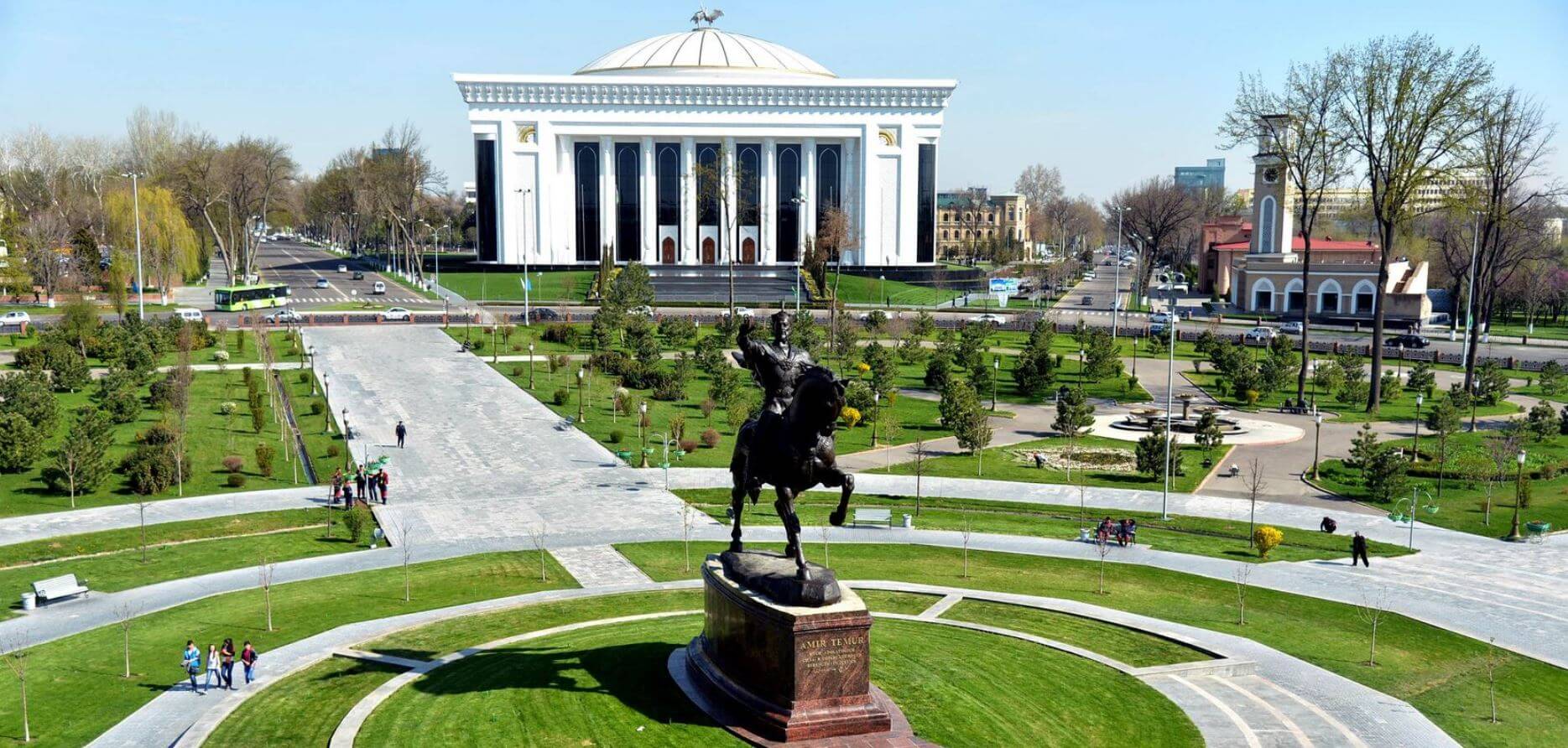
Amir Timur Square
The Historical & Symbolic Heart of the Modern Capital
Tashkent's central radial hub, crowned by the bronze equestrian monument of Amir Timur and framed by Soviet modernist landmarks and lush plane-tree gardens.
Central Tashkent (Junction of Amir Timur Avenue and Sharaf Rashidov)
Historic Public Square & Urban Parkway
Laid out in 1882; Amir Timur monument unveiled in August 1993
Imperial Russian urban architects; sculpture by Ilkhom Jabbarov
Military parade ground and central nexus of Tashkent's radial boulevard network
1 – 1.5 hours
What is Amir Timur Square?
Amir Timur Square (Amir Temur Xiyoboni) serves as the geographic, political, and architectural epicenter of modern Tashkent. Established in the late 19th century as the center of the Russian colonial new city, it is a circular public park from which eight broad avenues radiate like wheel spokes. In its center stands a towering bronze equestrian statue of the fourteenth-century conqueror and ruler Amir Timur (Tamerlane), representing independent Uzbekistan's national sovereignty and historic heritage.
Chronicles & Story
The central pedestal has witnessed the entire political drama of modern Central Asia: it has successively held monuments to Tsarist Governor-General Kaufmann, Karl Marx, Lenin, Stalin, and Karl Marx again, before the monumental bronze of Amir Timur was erected in 1993. Inscribed upon its pedestal in four languages is Timur's famous motto: 'Strength in Justice' (Kuch Adolatdadir). Surrounding the square stand iconic institutions: the twin Tashkent Chimes (Toshkent Kurantlari) erected in 1947 to honor WWII victory, the massive brutalist honeycomb facade of Hotel Uzbekistan, the Palace of International Forums, and the State Museum of the Temurids History.
Who Created It and Why?
Commissioned by the newly independent Republic of Uzbekistan to replace Soviet ideological statuary with a unifying national symbol. The bronze monument was sculpted by prominent Uzbek sculptor Ilkhom Jabbarov, depicting Timur on a spirited steed with his hand raised in a gesture of peace and protection.
Established: The square was first designed in 1882 by military cartographer Nikolai Ulyanov and architect Mikhail Chernyavsky as Konstantinovsky Square. Following the dissolution of the Soviet Union, the square underwent a profound ideological and aesthetic transformation, culminating in the dedication of the Amir Timur equestrian monument on August 31, 1993.
Architecture & Landscape Features
The square is an open-air exhibition of diverse architectural eras. On the eastern perimeter looms the colossal curvilinear facade of Hotel Uzbekistan (1974), celebrated globally as an icon of Soviet modernism with its cast-concrete sun-shading brise-soleil (panjara). On the southwest corner stands the historic brick facade of the 19th-century Men's Gymnasium (now Westminster International University). Fountains, manicured flowerbeds, and century-old oak and plane trees provide shade for pedestrians.
A Walking Tour of the Central Radial Boulevard
Exploring Amir Timur Square on foot reveals how imperial Russian planning, Soviet modernist architecture, and contemporary national symbolism seamlessly intersect.
The Equestrian Statue
A commanding bronze sculpture depicting Amir Timur in regal armor riding forward, symbolising national resurgence and justice.
Hotel Uzbekistan
An architectural icon of Soviet modernism featuring a dramatic textured lattice skin inspired by Central Asian sun screens.
Tashkent Chimes (Kuranty)
Historic bell clock towers built in 1947 from wartime clockwork mechanism brought from East Prussia.
Palace of International Forums
A monumental 21st-century neoclassical hall finished in brilliant white Thassos marble and Swarovski crystal chandeliers.
What Can You Do Here?
Take a Leisurely Evening Stroll
Walk the perimeter paths under the illumination of vintage lampposts as locals gather around the water fountains.
Photograph Hotel Uzbekistan's Facade
Capture the dramatic geometric shadow patterns cast by the hotel's concrete sunscreens in the late afternoon sun.
Visit the Adjacent Temurids Museum
Walk two minutes across the northern lawns to explore the blue-domed State Museum of the Temurids History.
Relax at Outdoor Terrace Cafes
Enjoy Uzbek green tea or espresso along nearby Sayilgoh Street (Broadway), the lively pedestrian promenade.
What Will You Discover?
The Re-imagining of National Heroes
Learn how Amir Timur was repositioned in post-independence Uzbekistan as a foundational statesman, patron of arts, and lawgiver.
Colonial Radial Urban Planning
Discover how late-nineteenth-century European city planners transformed Tashkent into a radial city with vast shaded boulevards.
Soviet Modernist Heritage
Gain a nuanced appreciation for Central Asian mid-century architectural experiments that blended brutalism with regional climate design.
Nearby Experiences
Immediately adjacent to the square is Sayilgoh Street (known locally as Broadway), filled with local street artists, portrait painters, and souvenir stalls. The State Museum of the Temurids History sits directly on the northern flank.
Continue Your Journey Through Uzbekistan
Tashkent connects directly by fast Afrosiyob rail to Samarkand, Bukhara, and Khiva.
.jpg) Timurid Capital
Timurid CapitalSamarkand
Turquoise double-domes, astronomical observatories, and vibrant paper mills.
.jpg) Spiritual Oasis
Spiritual OasisBukhara
Medieval madrasas, trading domes, and quiet shaded courtyards.
.jpg) Desert Citadel
Desert CitadelKhiva
Walled mudbrick open-air museum glowing amber at desert sunset.
Plan Your Visit to Amir Timur Square
Our local travel specialists craft personalized Uzbekistan itineraries connecting Tashkent with mountain escapes and Silk Road cities.