
Tashkent Metro
A Subterranean Palace Museum of Central Asian Architecture
Central Asia's first rapid transit system, famous for its magnificent marble halls, crystal chandeliers, cosmonaut mosaics, and thematic architectural grandeur.
Underground across all central districts, Tashkent
Public Transportation & Subterranean Architectural Ensemble
First line opened November 6, 1977; continuous modern expansions
Government of Uzbekistan & Soviet transit engineers; individual stations by prominent Uzbek artists
Earthquake-resilient mass urban transit and civil protection shelters
1.5 – 2.5 hours (station hopping tour)
What is Tashkent Metro?
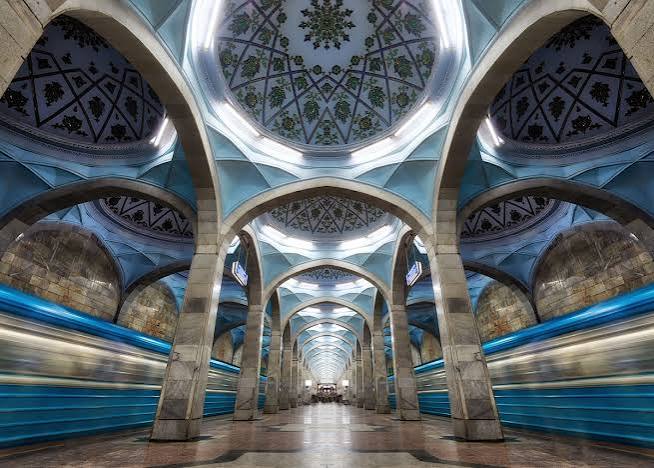
The Tashkent Metro is widely celebrated as one of the most aesthetically stunning underground transit networks in the world. Comprising four operational lines (Chilanzar, Uzbekistan, Yunusabad, and the Circle Line), each of its subterranean stations was individually conceived as a standalone work of civic art. Decorated with Ural marble, pink granite, hand-blown chandeliers, majolica tilework, and bas-relief sculptures, the system reflects Uzbekistan's classical poets, cotton harvests, space explorers, and national folk epics.
Chronicles & Story
Because the metro was originally classified as a strategic military defense facility, all photography and videography inside stations was strictly forbidden for four decades. In June 2018, the government lifted the ban, turning the metro into an international sensation for architecture enthusiasts, street photographers, and curious travelers. Today, clean, whisper-quiet trains transport over 500,000 riders daily through these subterranean art galleries.
Who Created It and Why?
Designed and constructed by thousands of engineers, miners, and master artists from Uzbekistan and across the former Soviet republics, the system aimed to solve urban congestion while presenting a showcase of Central Asian cultural pride and technological capability.
Established: Construction commenced in 1972 following the devastating 1966 Tashkent earthquake, which prompted engineers to design an ultra-resilient subterranean transit network capable of withstanding magnitude 9.0 seismic shocks. The first nine-station stretch of the Chilanzar Line commenced operations on November 6, 1977. Since 2017, the network has undergone dramatic expansion, including a new elevated ring line circling the capital.
Architecture & Landscape Features
No two stations are alike. Kosmonavtlar station honors Soviet space exploration with a deep blue-to-black gradient ceramic wall reminiscent of the Earth's atmosphere and porcelain medallions honoring Yuri Gagarin and Valentina Tereshkova. Alisher Navoi station evokes 15th-century Timurid architecture with soaring vaulted ribbed cupolas, blue tile rosettes, and wall panels illustrating scenes from Navoi's celebrated poems. Mustaqillik Maydoni (Independence Square) dazzles with gleaming white marble columns quarried in Gazgan and crystal chandeliers.
Explore Tashkent Underground: The Curated Station Route
To experience the architectural highlights of the Tashkent Metro, travelers should embark on a simple, inexpensive station-hopping route.
Alisher Navoi (Uzbekistan Line)
Vaulted dome ceilings inspired by medieval mosques with intricate majolica tilework and scenes from Navoi's literary masterpieces.
Kosmonavtlar (Uzbekistan Line)
Cosmic deep-blue atmosphere with floating astronaut medallions honoring Ulugh Beg, Gagarin, and space pioneers.
Mustaqillik Maydoni (Chilanzar Line)
Pristine white Gazgan marble colonnades and sparkling crystal lighting reflecting the dignity of the central state square above.
Pakhtakor (Chilanzar Line)
Vibrant ceramic mosaics celebrating Uzbekistan's cotton heritage and agrarian identity with turquoise and emerald hues.
What Can You Do Here?
Embark on an Architectural Metro Safari
Hop effortlessly between lines using a single 2,000 UZS ticket (contactless bank cards accepted) to photograph iconic stations.
Observe Ceiling Vaulting at Alisher Navoi
Look straight up inside the central hall of Alisher Navoi to study the Islamic muqarnas geometry executed in Soviet concrete.
Experience Daily Urban Life
Ride alongside local students, grandmothers, and commuters in impeccably clean, air-conditioned transit cars.
Emerge at Key City Landmarks
Use metro exits directly adjacent to Chorsu Bazaar, Amir Timur Square, and Independence Square without surface traffic delays.
What Will You Discover?
Seismic Engineering Triumph
Understand how the Tashkent Metro was engineered to be completely safe during major earthquakes through flexible joint segments.
Cultural Storytelling Beneath Ground
Learn how the station themes intentionally bridge ancient Central Asian literature with 20th-century scientific accomplishments.
Public Transit as Fine Art
Appreciate a philosophy of public infrastructure where everyday citizens travel through palatial spaces daily.
Nearby Experiences
Alisher Navoi station connects underground directly to Pakhtakor station via a decorative pedestrian concourse. Exits place visitors within walking distance of the central parks, modern shopping malls, and pedestrian boulevards.
Continue Your Journey Through Uzbekistan
Tashkent connects directly by fast Afrosiyob rail to Samarkand, Bukhara, and Khiva.
.jpg) Timurid Capital
Timurid CapitalSamarkand
Turquoise double-domes, astronomical observatories, and vibrant paper mills.
.jpg) Spiritual Oasis
Spiritual OasisBukhara
Medieval madrasas, trading domes, and quiet shaded courtyards.
.jpg) Desert Citadel
Desert CitadelKhiva
Walled mudbrick open-air museum glowing amber at desert sunset.
Plan Your Visit to Tashkent Metro
Our local travel specialists craft personalized Uzbekistan itineraries connecting Tashkent with mountain escapes and Silk Road cities.